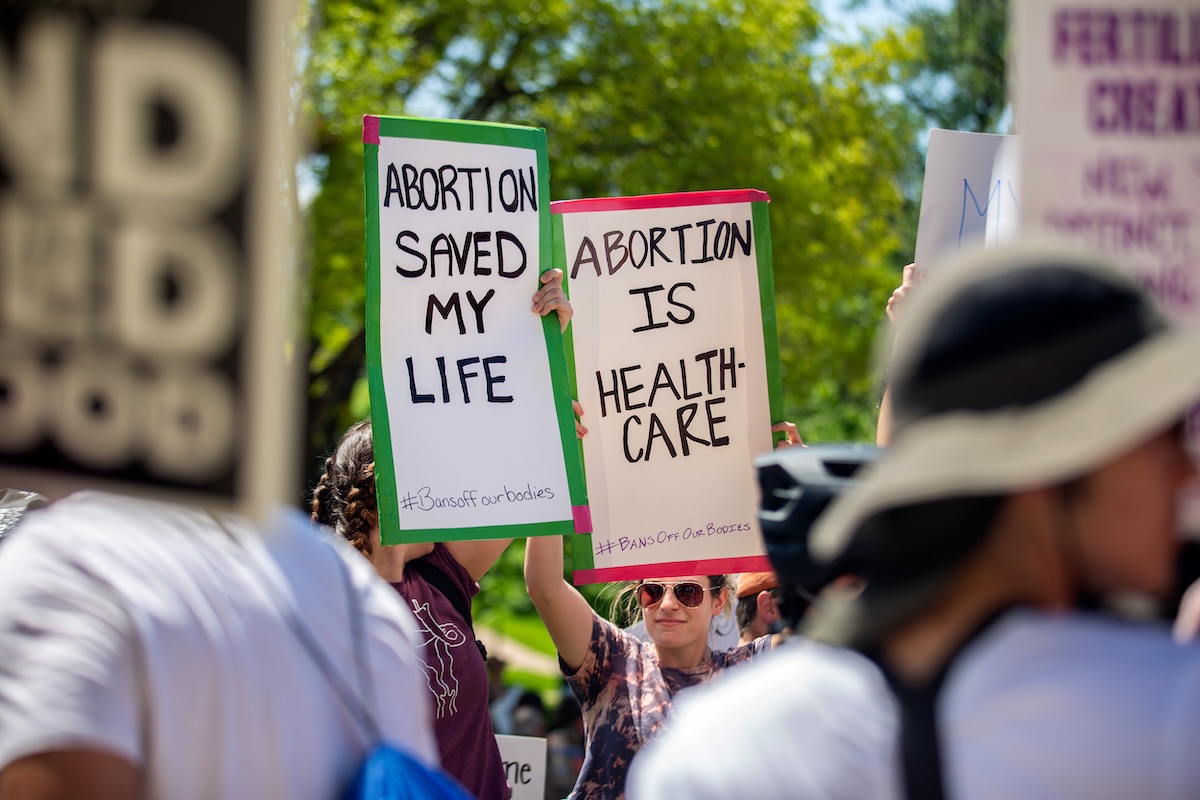
In 2022, after the Supreme Court’s Dobbs decision overturned Roe v. Wade, a trigger ban in Texas went into effect. This meant that for doctors, performing an abortion after the moment of fertilization in pregnancy, became a punishable felony. In fact, those who violated could face up to life in prison. While there were exceptions, such as “a life-threatening physical condition aggravated by, caused by, or arising from a pregnancy,” exactly how and when such an exception would be honored were unclear.
Not long after, in 2023, 34-year-old Kyleigh Thurman started to unexpectedly bleed heavily. She did not know she was pregnant at the time, but her doctor encouraged her to take a pregnancy test. It was positive. She continued to experience cramping, dizziness and more bleeding. She ended up having to go to the ER a total of six times to receive proper treatment and a diagnosis. Doctors first sent her home, telling her she was just experiencing a miscarriage. Eventually, tests confirmed she had an ectopic pregnancy.
“I was advocating so hard for myself,” Thurman told Salon in a phone interview. “I was going to the hospital, I was vocal, I was saying, here’s my OB, here’s my records, she’s saying explicitly, this is ectopic, and none of the ER doctors would respond.”
Doctors only gave Thurman a methotrexate injection, a medication treatment, when her OB-GYN went to the hospital and spoke to the staff in person on her fourth visit to the emergency room. Several days after the injection, she had to have emergency surgery after showing signs of an ectopic pregnancy rupture. She ended up having to have her right fallopian tube removed.
Her story is unfortunately not unique. With the Dobbs decision, public health experts warned the restrictive abortion laws that followed would endanger the lives and health of all women. Not only would those with unintended pregnancies would suffer, but also those who were miscarrying or had emergency situations like ectopic pregnancies. In other words, anyone with a uterus.
A new study published in JAMA this month found that, nearly four years after Dobbs, abortion bans are indeed affecting standard, evidence-based care of miscarriages. Specifically, the study found a shift away from medication management when treating a miscarriage — like using the abortion drugs mifepristone and misoprostol combination — to “expectant management,” which is when a person waits for a miscarriage to happen on its own without intervention, usually the only option in abortion ban states.
The researchers looked at data between 2018 and 2024 of more than 123,000 individuals who experienced a miscarriage before 10 weeks of pregnancy. According to the study, abortion bans were associated with a 2.8% increase in expectant management and a 2.2% decrease in medication management. Among those who did receive medication, abortion ban states had a 13.8% increase in misoprostol-only regimens compared to combining it with mifepristone. Despite many abortion bans having so-called “exceptions,” discretion in many of these laws has been left to physicians, who in many cases, face serious penalties if these laws are violated.
“Patients are having to wait longer to receive treatment, and when they arrive, they have fewer choices,” Maria Rodriguez, director of the OHSU Center for Women’s Health and co-author of the study, said in a statement. “These are very real and dangerous clinical implications for the hundreds of thousands of women experiencing miscarriages annually.”
In an interview with Salon, Rodriguez said she was a little surprised that the effect wasn’t greater, but noted that the population studied had private insurance — people who usually have more resources than those who are uninsured or on Medicaid. She added that there are likely several factors contributing to the effect she and her colleagues observed.
“There could be fewer doctors available to provide care given the research showing doctors and other clinicians are leaving states with abortion bans,” Rodriguez said. “Fear of violating abortion bans may also delay care, but so could increased restrictions on mifepristone.”
“Fear of violating abortion bans may also delay care, but so could increased restrictions on mifepristone.”
The American College of Obstetricians and Gynecologists explains that there are three main ways to treat a miscarriage, with a goal of removing any tissue left from the pregnancy in the uterus. The two nonsurgical treatments are expectant management and medication management; the third option is a surgical procedure called dilation and curettage (also known as D&C). Medication management, such as mifepristone plus misoprostol and a D&C are also used for terminating unwanted pregnancies. In many cases, ACOG advises patients experiencing a miscarriage to choose the treatment they prefer in this situation.
Dr. Rachel Jensen, an OB-GYN and specialist in complex family planning, told Salon that this study contributes to a growing body of evidence suggesting that the Dobbs decision and subsequent state abortion laws have had “significant impacts on care, beyond access to induced abortion.”
“Uncertainty about the law and fear of legal repercussions can result in delays or limitations to evidence-based management options for patients experiencing pregnancy loss,” Jensen said.
When looking at the study, Jensen said it is particularly “concerning” to see that abortion ban states saw a decline in use of mifepristone, which “reflects growing access disparities between restricted and non-restricted states, which could further widen existing disparities in maternal mortality and morbidity.”
Jensen added that patients are put at an increased risk of complications — such as infection or hemorrhage— when they aren’t presented with all options. These complications could require more invasive procedures, lengthy hospital stays or could even lead to death.
Rodriguez said their current study is now looking at the outcomes of the treatment of ectopic pregnancies.
David Hackney, a maternal-fetal medicine specialist who was not involved in the study or Thurman’s case, told Salon he was not surprised to see this data published and to hear these stories.
“Individual stories of altered and suboptimal miscarriage management emerged quickly in the days following Dobbs, including several overtly tragic examples,” he said. “Abortion is never siloed, but rather intersects broadly with obstetrics and medicine itself, such that legislative efforts to restrict abortion ripple inevitably through other aspects of patient care.”