Candidates affiliated with Democratic Socialists of America, an organization well to the left of the Democratic Party, have scored wins in several of the party’s competitive primaries. It’s very likely that they will win House seats in the November 2026 elections since the candidates reside in progressive strongholds.
Although those candidates have drawn much attention, this is hardly a new trend. Bernie Sanders, the nation’s most prominent identified democratic socialist, has represented Vermont in the House or the Senate since 1990. U.S. Rep. Alexandria Ocasio-Cortez of New York, the movement’s rising star in Congress, has served in the House since 2019. New York Mayor Zohran Mamdani successfully campaigned as a DSA member in 2025.
Despite the historical precedents, some prominent Democrats are cautious about leftist victories. Meanwhile, many Republicans and President Donald Trump have responded by claiming there’s a new wave of socialist and communist extremism that they say is threatening the American way of life.
There’s no one agreed-upon definition of socialism, even among avowed socialists themselves. But what if the word “socialism” can actually describe some of the most popular and important institutions in the United States?
I’m a social work professor who studies how people manage their money and their well-being. From both my research and informal conversations, I’ve learned that as much as Americans like to think we are, or should try to be, independent, we actually rely on one another and the government a great deal. I call this arrangement “interdependence.”
And even in a conservative state like North Dakota, where I live, socialist, or interdependent, arrangements are seen as pillars of the community. It’s where helping each other gets a little more formal structure.
What words mean can change.
To “slay,” for example, means to kill. For younger Americans, it has come to also mean to do something impressively. The way words are perceived can change too, with connotations morphing from negative to positive.
The way Americans perceive socialism is apparently undergoing such a transition. Whereas before, socialism has largely had a negative stigma associated with it, many Democrats and independent voters are now increasingly viewing socialism as a system with a strong safety net and a way of bringing harms of the free market under control.
The word is now being viewed more positively than it used to, according to pollsters – especially among Democrats. It is associated with being able to afford life’s necessities and the kind of strong economic rights found in Norway and other Scandinavian countries.
Given how poorly many Americans are faring under capitalism, I think that the growing openness to democratic socialist candidates makes sense.
The number of people who have to work multiple jobs to make ends meet reached 9.4 million in November 2025, the highest level since the Bureau of Labor Statistics started tracking that indicator in 1994. Meanwhile, support for capitalism fell to 54% in 2025, from 60% four years earlier.
Meanwhile, most workers find themselves on the hook to fund more of their own retirement than their parents did and to pay more for their healthcare and insurance coverage, hindering their efforts to save for retirement. Many service sector workers find that they only get shifts when an algorithm says their labor is required – leaving their schedules and earnings unpredictable.
For those who have joined the workforce since the Great Recession, an economic downturn that lasted from late 2007 until mid-2009, financial insecurity has largely defined their economic experiences. Millions of American families are left needing to pay more and more to cover their bills, and with less disposable income.
As benefits for low-income people are being cut or made harder to access, many Americans find the prospect of having a stronger safety net more attractive. That is, they indicate that they would prefer a more regulated kind of capitalism – softened with a socialist cushion to ease its negative effects.
Policy platforms to increase housing access, improve working conditions and make utility bills more affordable are a few of the priorities that have propelled democratic socialist and other very progressive candidates to recent victories in their primaries.
North Dakota is very rural and so conservative that the last Democrat to win the state’s Electoral College votes was Lyndon B. Johnson in 1964. And Republicans are even less in favor of socialism today than they used to be, the Gallup polling organization has found.
But even here, the Democratic Socialists of America have formed a chapter. Ruth Buffalo, who served in the North Dakota House of Representatives from 2019-2022, originally won with the DSA’s endorsement.
I think it’s fair to say that North Dakota has a long history of maintaining policies and running companies and other institutions that could be considered socialist. And that can hold true no matter how you define socialism or whether you think it’s a good thing.
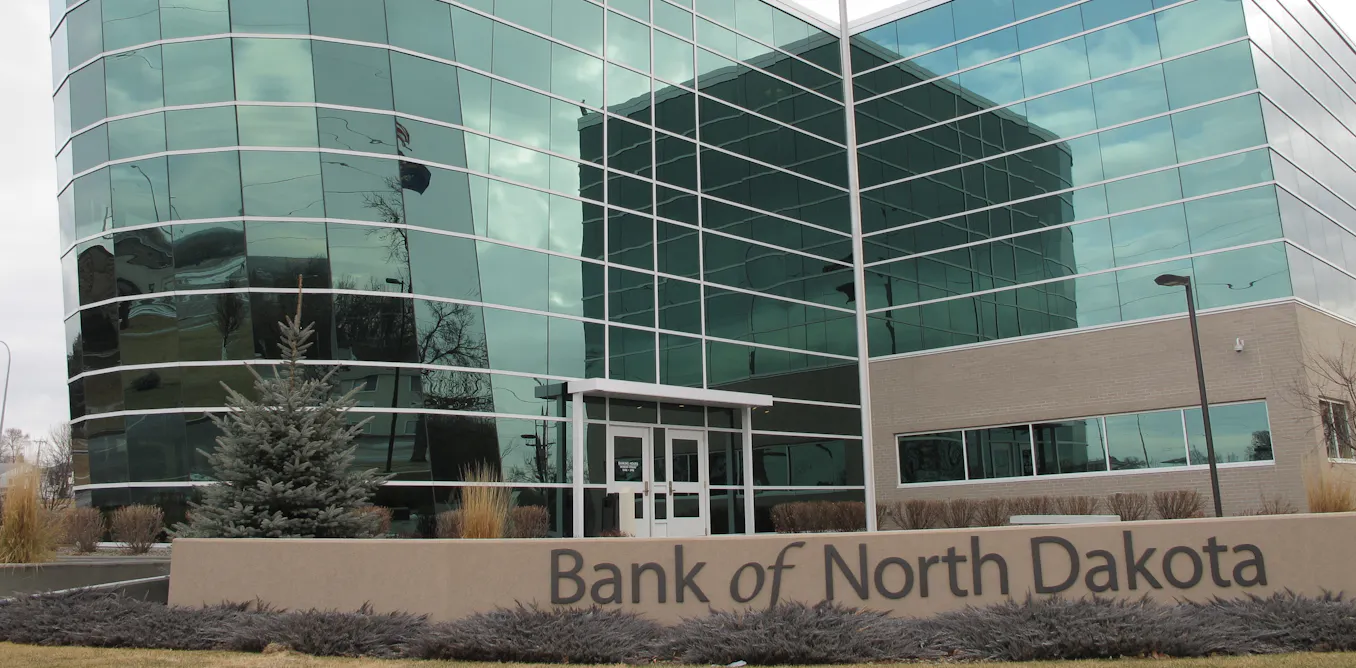
Consider the state-owned Bank of North Dakota, the only financial institution of its kind in the United States. Founded in 1919, it offers numerous education, business, agriculture and infrastructure loan programs to support the economic development of the state and its citizens.
North Dakota also has Gate City Bank, which was established in 1923. It’s a mutual bank, meaning it’s owned by members who bank there, not shareholders. It’s the largest bank in the state by number of branches and fifth-largest by total assets. Credit unions, another kind of membership-based financial institution, also thrive in the state.
Agriculture and farming are a mainstay of North Dakota’s economy.
Rather than send wheat to Minneapolis to be processed, incurring high transportation costs, farmers and the state banded together to form the North Dakota Mill, the only state-owned mill in the United States. Notably, no public funds support the mill. Instead, the mill supports the state, with 50% of its profits going to the public coffers.
Cooperatives, a form of member-owned business, are plentiful in North Dakota too. They support industries such as agriculture, electric utilities and fuel and convenience stores.
All of these examples ultimately result in economic benefit and opportunity. For instance, co-ops can reduce the risks of trying to go it alone to launch a small business.
With food insecurity and school lunch debt a problem for many families, many North Dakotans are looking to the state to control the situation – a socialist notion. A ballot measure with significant public support will be put to state voters on Nov. 3, 2026. If approved, the state would have a constitutional mandate to provide free lunches and breakfasts for all K-12 public school students.
So while many Americans still don’t like the idea of socialism when they hear that word, it really is a matter of semantics: The word itself is loaded, but few would deny that these examples really do lead to a better quality of life by putting people first.
For example, millions of older Americans rely on Social Security benefits and Medicare health insurance coverage to stay out of poverty. Nearly 40 million Americans of all ages get Supplemental Nutrition Assistance Program benefits to help them buy groceries.
And in much of the country, the government is responsible for operating water and other utilities, running fire departments and operating public libraries. Those services keep many communities healthy, safe and informed.
Cooperating for the benefit of our families, our communities and our cities, states and nation is what’s kept us progressing as a society. If you can look past the label, I think that you might see arguably socialist programs operating at the national level and in states like mine as opportunities to live a good life by working together.
Assistant Professor of Social Work, University of North Dakota
Jeffrey Anvari-Clark is not affiliated with any political party or organization. He is a member at Gate City Bank.
University of North Dakota provides funding as a member of The Conversation US.